The think tank: turning your ideas into work the loop can build
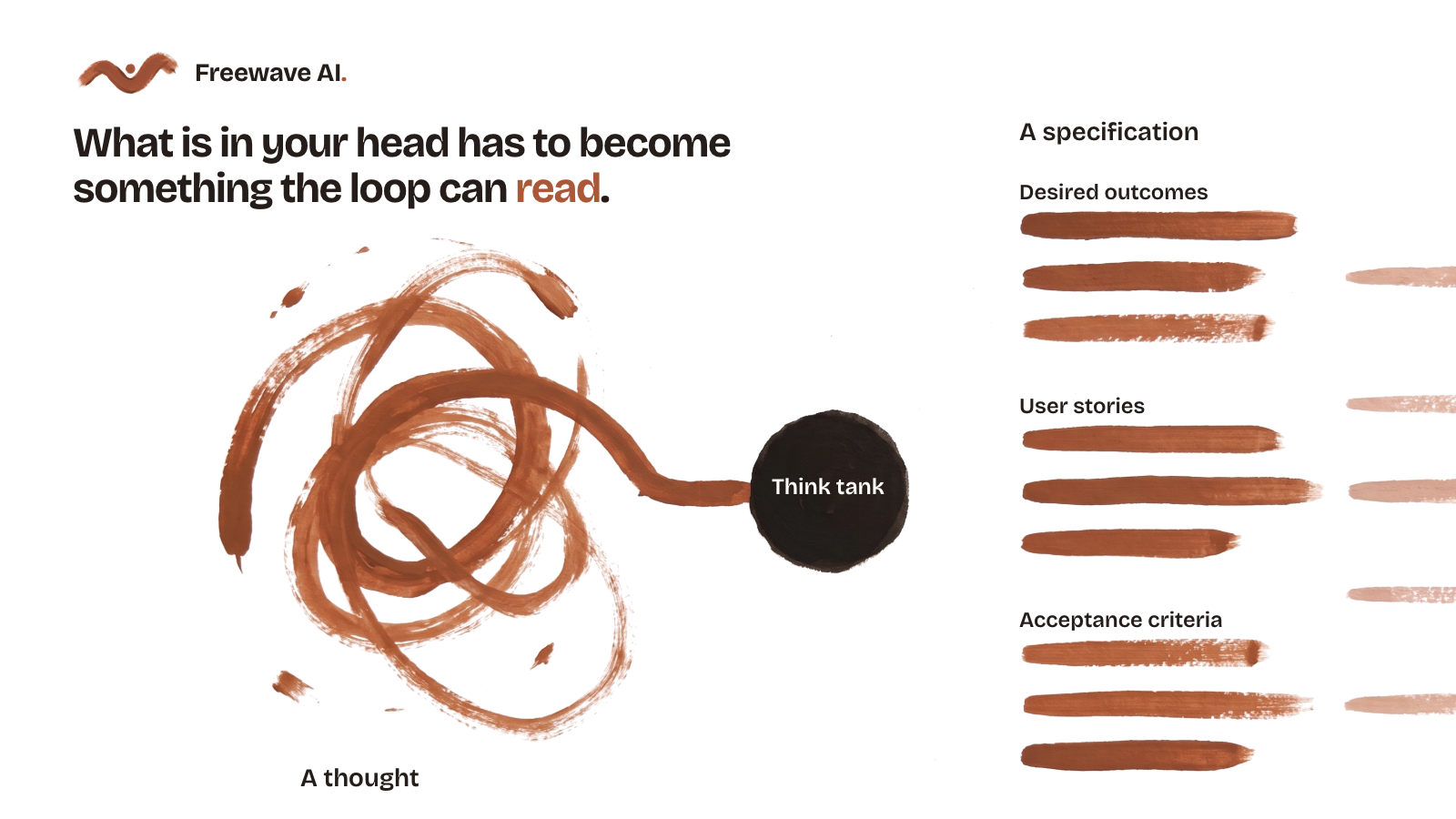
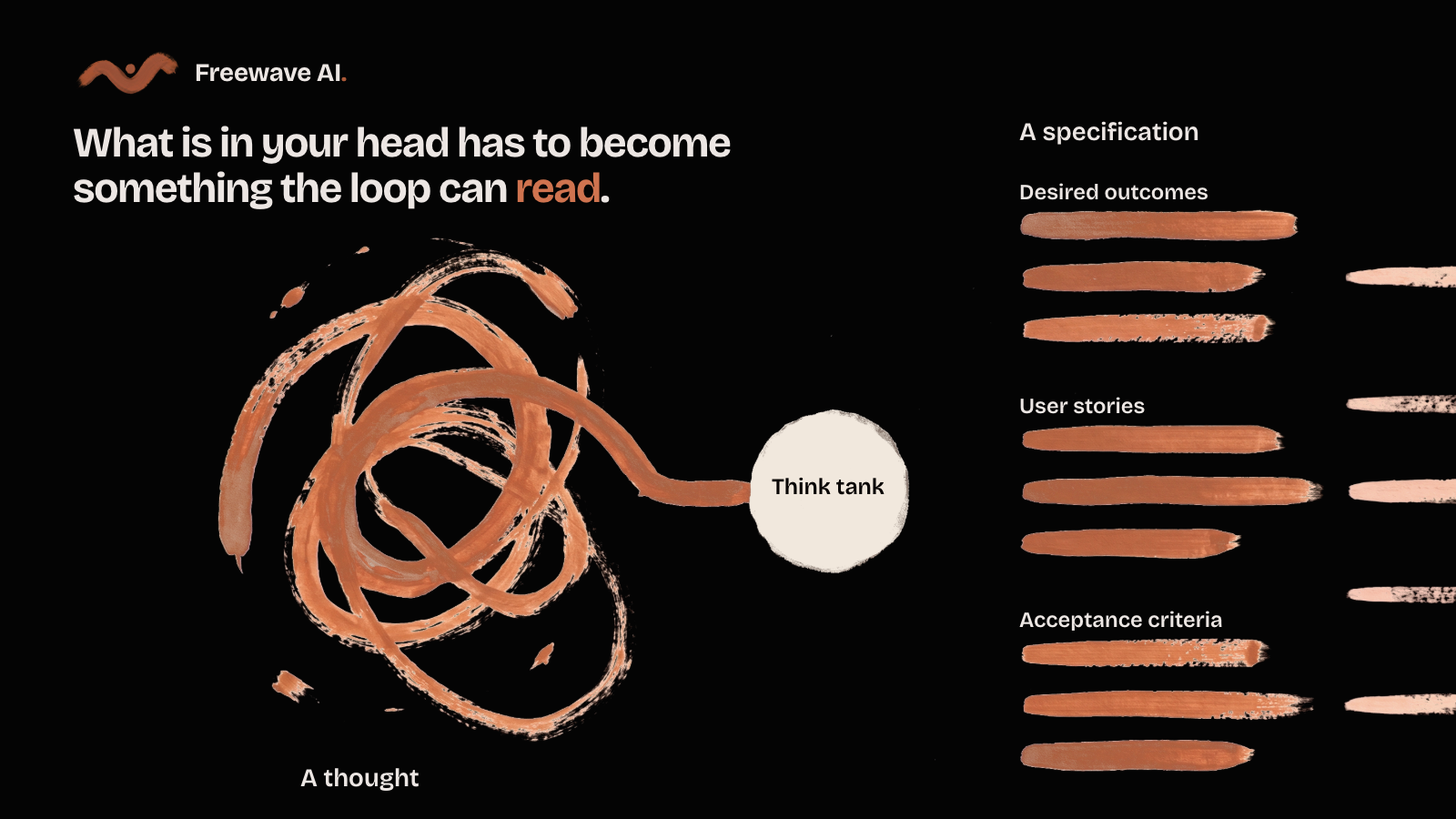
Much of the work in our release loop happens without anyone talking about it. A bug turns up, gets researched, fixed, tested and reviewed, and the founder sees the fix. Nobody needs to sit down and discuss it.
Ideas are different. An idea starts in your head, half formed, often on a walk or straight after a sales call. The agents in the loop cannot read your head. They can only act on what is written down, and they act on exactly that.
The think tank is the step in between. It takes what you are thinking and turns it into writing the rest of the loop can act on. This guide shows how that works for a quick idea and for a big one, and how to do the same with the tools you already have.
The mindset: the hand-over decides the rest
Everything after the think tank is built to follow what is written. The product owner splits the work up, the builder builds it, the tester checks it against the words on the ticket. None of them can see what you meant but did not write.
So the hand-over sets the direction for everything after it. A clear one turns into the feature you pictured. A vague one gets built just as carefully, and comes back as something you did not quite mean. That may make the think tank the most important part of the whole loop, even though it builds nothing.
What goes in, and what does not
Your ideas and requests go to the think tank: something a customer asked for on a call, a thing you want to try, a feature you have been turning over for weeks. In our loop the think tank is an agent you message the way you would message a colleague. Ours is called Atlas.
Bugs do not go there. A bug is researched and fixed inside the loop, with no conversation, so the think tank never becomes a queue that everything waits behind.
A small idea, sent on the go
Say you run a booking app. Walking back from a call, you think: people should get a reminder the evening before. You send the think tank one line: "Reminder the night before a booking?"
It comes back with a question or two. A push notification or an email? What if someone books that same evening? You answer in a line each. Then it writes the idea out and sends it back:
- Desired outcome: customers stop forgetting bookings they made days ago.
- User story: as a customer, I want a reminder the evening before my booking, so that I turn up.
- Acceptance criteria: a push notification at 6pm the day before; no reminder for a booking made after 6pm that day; nothing sent for a cancelled booking.
You read it, change 6pm to 7pm, and it goes on to the product owner. Five minutes, most of them spent walking.
A bigger feature, explored together
Now say you want customers to pay inside the app. That is not one message. The think tank explores it with you over a longer conversation, perhaps across a few days. Who pays, and when? What happens with a refund? What do customers do today instead? What waits while this gets built? It asks, it looks things up, and it lays out what each choice would mean.
A big idea rarely leaves as one piece. Payments might come out as several tickets: taking a payment, refunds, receipts, what the business sees. Each one goes into the loop with its own outcome, stories and criteria. The product owner then splits each of those further, until the builder has small pieces it can finish and the tester can check. One idea can end up as a hundred small tickets, all built from that one conversation.
You keep the decision
The think tank asks the questions and does the writing. It does not decide what your product becomes. Whether an idea goes ahead, waits or gets dropped stays with you, and so does the last word on what it wrote. The read-back is where you steer: it is the cheapest moment to change what gets built.
Try it with the tool you already use
You do not need our loop to work this way. Any AI chat tool can play the think tank once you give it the job.
- Say the idea out loud or type it as a message, however rough.
- Ask the tool to keep asking questions until it can write the desired outcome.
- Have it write the outcome, a user story or two, and the acceptance criteria.
- Read it back slowly. Where the tool was unsure, it may have filled the gap with a guess that sounds right.
- Correct what is wrong, in your own words, and let it rewrite.
- Hand it on: to a fresh building session, to yourself tomorrow, or to us.
For a quick idea, that is a few messages. For a big feature, step two is the conversation, and it takes as long as it needs.
Where it gets hard
The read-back is the step most worth doing and the easiest to skip. The writing looks finished, so it is tempting to wave it through. A wrong line here becomes a wrong ticket, and then a lot of them.
The other trap is sending everything through the think tank. Not every thought needs a conversation. A bug or a broken link can go straight into the loop. The think tank is for the things only you can explain.
Where we come in
We run this loop for founders. We connect to your app and backend and keep design, specs, building, testing and release moving, day and night. You decide the direction. If you want to talk through how a think tank would work for your app, or would rather have the whole loop running behind it, talk to Mandy on this site.
Get the weekly guide
Sign up for our weekly guide and we will send you a new one every week, each about one part of the loop.
Guide resources
The one-page PDF of this guide is for weekly guide subscribers.
Stuck on your own loop?
Ask Mandy, our AI assistant. She can tell you how we would set it up for your app.